“As for you, you whitewash with lies; worthless physicians are you all. Oh that you would keep silent, and it would be your wisdom! Hear now my argument and listen to the pleadings of my lips. Will you speak falsely for God and speak deceitfully for him?” – Job 13:4-7
We are all products of our age. Assumptions we make about reality and truth are called our Worldview. The problem for us is that we cannot always see the prejudices of our assumptions, and when we interpret everything through the lens of our own understanding we often create misunderstandings without realizing it. This is also true of how we apply our assumptions to the interpretation of Scripture.
The Bible has faced many challenges throughout the ages. No one now questions whether the earth revolves around the sun, or the fact that the earth is not the physical center of the universe. However, that notion created a great challenge to the integrity, authority, and reliability of the Scriptures for the Church of Galileo’s day. In the late 18th Century, new challenges to Scripture arose largely due to the advent of Enlightenment Rationalism. A field of study, called the Historical-Critical Method, began to challenge the reliability of the historical nature of the Bible. One problem was the conflicting timelines in the Gospels themselves, with slight variations of the sequences of the stories. Since it was assumed by the interpreters that biblical, historical literature would follow a strict chronology, as any modern historian would, then the various timelines of the Gospels could be reconciled. A project called the Synoptic Gospels attempted to align historical events in Matthew, Mark, and Luke into parallel columns. Because of the apparent contradictions in the timelines of the Scriptures, it was then assumed by critics that the Scriptures were not reliable or historical. Because of these apparent contradictions, many critics jumped on the texts in an effort to attack or disprove Christianity, the Bible, and religion in general.
This critical line of thinking came to its inevitable conclusion within Christian Theology in the works of Rudolph Bultmann, who denied the possibility of the miracles and the resurrection of Jesus Christ because they were not scientific and the result of primative thinking of people in a pre-scientific age. We can see here that Bultmann was clearly imposing his own Newtonian Worldview upon the text. Is it possible that only what we can prove through repeatable experiment is true? Or is God, if he exists, bigger than our microscope? Can God abridge what we call “reality” and do whatever He wants?
At the same time as Historical Critism was gaining popularity, Darwinianism and the Theory of Evolution provided a second significant challenge to Biblical accounts of creation and sacred history. Darwin’s works in 1858 and 1871 provided religion’s antagonists with more ammunition, and again the Church felt threatened and cornered by these events.
As a reaction to these attacks, a branch of theology known as Fundamentalism began in Princeton in the late 1800’s. It’s goal was to preserve faith in the veracity of the Scriptures. Fundamentalism’s principal tenant is that the bible is “inerrant”:
Biblical inerrancy, as formulated in the “Chicago Statement on Biblical Inerrancy“, is the doctrinethat the Protestant Bible“is without error or fault in all its teaching”;[1]or, at least, that “Scripture in the original manuscripts does not affirm anything that is contrary to fact”.[2]
In layman’s terms, the idea of the Bible being inerrant is that whatever it teaches is literally true. While not the same as Fundamentalism, Literalism is an extension of the attempt to prove the faithfulness of the Scripture in all that it teaches.
The Problem with Fundamentalism
The problem with Fundamentalism is not the fact the Scriptures are true, but in understanding the way they are true. Fundamentalism’s weakness is that it is playing on the same field and by the same rules set up for it by Enlightenment Rationalism. A fundamental approach to the Bible assumes that that the record of the Scriptures, specifically the Gospels, is meant to be be taken in a strict chronological manner, when chronology was not the concern of the writers at all. In other words, Fundamentalism is imposing an Enlightenment Rationalist framework on the Scriptures as an historical record, but does not understand the intent, the method, and literary purpose of the Gospel writers. In the end, fundamentalists fight for truth but lose the battle because the Scripture itself contradicts their understanding.
What do I mean by this statement?
I think is rather naive to think that just because someone has found in the Bible apparent conflicts and passages which offend modern sensibilities, that someone has somehow been able to disprove the value and validity of the Scriptures. It is naive to think one has discovered the “gotcha” – without having spent years investigating the historical and cultural context of the writers and weighing the arguments fairly on either side.
Both fundamentalists who defend the scriptures and atheists who attack the chronological inconsistencies, and minor reporting errors, in the New Testament have made a significant cultural mistake. They are treating the writers of the New Testament as if they were the product of the age of Enlightenment Rationalism and were trying to create an exact, journalistic report of events in sequence. Nothing could be further from the truth. The Gospel writers were not writing down facts in order of occurrence, they were using historical events to show how the life of Jesus fulfilled the prophetic typology of the Scriptures. In other words, while being faithful to the events, they were not very concerned to live up to our historical methodology. The writers were creative theologians, using the life of Jesus to show how his life fulfilled the scripture’s predictions about the Messiah.
We have an historical attestation to this effect from the 2nd Century Papias, who said,
“Mark having become the interpreter of Peter, wrote down accurately, though not in order, whatsoever he remembered of the things said or done by Christ. For he neither heard the Lord nor followed him, but afterward, as I said, he followed Peter, who adapted his teaching to the needs of his hearers, but with no intention of giving a connected account of the Lord’s discourses, so that Mark committed no error while he thus wrote some things as he remembered them. For he was careful of one thing, not to omit any of the things which he had heard, and not to state any of them falsely…So then Matthew wrote the oracles in the Hebrew language, and every one interpreted them as he was able.”
So, to my mind, minor divergences of reportage on small details does not destroy the credibility on the widespread agreement of the authors on the major points. Jesus was crucified, Jesus died, Jesus was astoundingly raised from the dead. In fact, without his resurrection, they would have had no motivation to write anything, since immediately after his death they were all running for their lives afraid the same fate was to befall them…
Just to sum up the point: how can you know the meaning and validity of the scriptures if you don’t know the authors’ purpose, literary method, and intent? There is a literary form and structure of the Gospels, which most people miss. They were publicists, not simply historians. The Gospels are a literary genre called typologies. They wanted to show how Jesus is the fulfillment of the types revealed in the Old Testament books. They organized and arranged the events of Jesus’ life to fit the literary pattern of the first 6 books of the Bible. Matthew, Luke, and John, all use a different books of the Tanakh to reveal how the events of Jesus’ life are the fulfillment of the First Covenant. Matthew records Jesus’ 40 days and nights in the wilderness and his subsequent Sermon on the Mount. This part of Jesus’ life fulfills the paradigm of Exodus, where Moses is on the Mount for 40 days and nights and brings down the 10 Commandments and teaches the people from the mountain. Jesus is the new Moses, according to Matthew. Luke, however records Jesus’ Sermon on the Plain which follows the book of Deuteronomy where Moses recounts the history of the Law on the Plain outside the promised Land. Again, to Luke, Jesus is the new Moses. John uses the book of Joshua {Joshua is the Hebrew name for Jesus} to reveal how Jesus’ crossing the Jordan river corresponds to Joshua’s crossing the river when the people of Israel entered the Promised Land. Jesus is the new Joshua, bringing the people of God into the New Promised Land of the Spirit by his death and resurrection…
My point is this: if you don’t understand what the authors’ intent and purpose were, you cannot impose upon them modern, journalistic forms and expect the results you want, either for or against. You are arguing apples against oranges. Fundamentalism, by imposing a modern day historian’s method upon the texts of the Bible, is unconsciously assuming an Enlightenment Rationalist’s Worldview, and does not understand the purpose and intent of the writers. And critics of the truthfulness of Scripture have proven nothing by pointing out such inconsistencies, because they are “proving” false what the writers never intended to be true in the first place. They are, however, scoring points against a Fundamentalist’s interpretation of the Scriptures, but they are not disproving that the Bible. Atheists and antagonists may be reacting to the defensiveness of Christians, who insist on setting up arguments that can clearly be shown to be false in defense of their God, but they have not disproven the Scriptures at all. The Bible’s truth is infallible. Its moral teaching inviolate and timeless. But to understand its truth, you need to know what the writer actually intended.
For example, while the sun does not actually rise in the East, but the earth rotates towards the dawn, as we now know, the truthfulness of the Psalmists’ declaration does not change: all Creation declares the Glory of God. It is still God’s Word to humanity. You just need to understand how and in what way. It is worthy to be believed and followed. We just have to trust that God inspired the writers to use the liberty of a creative theological purpose in assembling the events of Jesus’ life.
Why did Jesus have to be baptized by John? He said, “it is necessary to fulfill all righteousness…” What did Jesus mean by that?
Why are there no records of miracles by Jesus as a child?
What did it mean for Jesus to be fully human?
What does it mean when it says that Jesus “emptied himself… being born in human likeness”?
Philippians 2:5-11 “Let the same mind be in you that was in Christ Jesus, who, though he was in the form of God, did not regard equality with God as something to be exploited, but emptied himself, taking the form of a slave, being born in human likeness. And being found in human form, he humbled himself and became obedient to the point of death–even death on a cross. Therefore God also highly exalted him and gave him the name that is above every name, so that at the name of Jesus every knee should bend, in heaven and on earth and under the earth, and every tongue should confess that Jesus Christ is Lord, to the glory of God the Father.”
Jesus was not omniscient. As a child, it says of him:
Luke 2:52 “And Jesus grew in wisdom and stature, and in favor with God and men.”
How can you grow in wisdom if you are all knowing?
He was not all powerful:
John 5:19 Jesus gave them this answer: “I tell you the truth, the Son can do nothing by himself; he can do only what he sees his Father doing, because whatever the Father does the Son also does.”
John 12:48-50 The one who rejects me and does not receive my words has a judge; the word that I have spoken will judge him on the last day. For I have not spoken on my own authority, but the Father who sent me has himself given me a commandment–what to say and what to speak. And I know that his commandment is eternal life. What I say, therefore, I say as the Father has told me.
He had to suffer as we do:
Hebrews 4:15 For we do not have a high priest who is unable to sympathize with our weaknesses, but one who in every respect has been tempted as we are, yet without sin.
Hebrews 5:7-9 In the days of his flesh, Jesus offered up prayers and supplications, with loud cries and tears, to him who was able to save him from death, and he was heard because of his reverence. Although he was a son, he learned obedience through what he suffered. And being made perfect, he became the source of eternal salvation to all who obey him…
Example: A Cross of Wills
It would have been no challenge for God in his omniscience and omnipotence to resist temptation. There would have been no redemption for us in that, but Jesus had to face temptation as a human being and be as tempted as we are, but not sin, for there to be any redemption for us.
Adam and Eve failed in temptation:
Genesis 3:6 “So when the woman saw that the tree was good for food, and that it was a delight to the eyes, and that the tree was to be desired to make one wise, she took of its fruit and ate, and she also gave some to her husband who was with her, and he ate.”
John calls these “the lust of the flesh and the lust of the eyes and the pride of life, ” 1 John 2:16
Jesus faced this temptation and passed it, unlike Adam and Eve:
Matthew 4:1-10 Then Jesus was led up by the Spirit into the wilderness to be tempted by the devil. And after fasting forty days and forty nights, he was hungry. And the tempter came and said to him, ‘‘If you are the Son of God, command these stones to become loaves of bread.’’(LUST OF THE FLESH) But he answered, ‘‘It is written, ‘Man shall not live by bread alone, but by every word that comes from the mouth of God.’” Then the devil took him to the holy city and set him on the pinnacle of the temple and said to him, ‘‘If you are the Son of God, throw yourself down, for it is written, ‘He will command his angels concerning you,’ and ‘On their hands they will bear you up, lest you strike your foot against a stone.’” (PRIDE OF LIFE) Jesus said to him, ‘‘Again it is written, ‘You shall not put the Lord your God to the test.’’’ Again, the devil took him to a very high mountain and showed him all the kingdoms of the world and their glory.(LUST OF THE EYES) And he said to him, ‘‘All these I will give you, if you will fall down and worship me.’’ Then Jesus said to him, ‘‘Be gone, Satan! For it is written, ‘You shall worship the Lord your God and him only shall you serve.’’’
But he was tempted as we are, and even more so in the Garden before he went to the Cross.
In Order for Jesus to fulfill his ministry as prophet, priest and king, he had to be anointed with power, wisdom, and strength by the Holy Spirit, which he received at baptism.
John, the last in the long line of prophets, but also the son of a priest, anointed Jesus both as prophet and as the high priest.
The point is: Jesus had to rely completely on the Father and upon the Holy Spirit to do his miracles and to fulfill his ministry, just as we must. It was in his humanity that he did these things, giving us an example of what perfect trust in and obedience to the Father looks like in a human being. If Adam had not have sinned, this is what we would have been able to do!
When he emptied himself, he gave up his glory and power to become weak and as human as we are. It says that he became physically weary after walking to Samaria (John 4:6)
Hebrews 2:14-18 “Since the children have flesh and blood, he too shared in their humanity so that by his death he might destroy him who holds the power of death–that is, the devil– and free those who all their lives were held in slavery by their fear of death. For surely it is not angels he helps, but Abraham’s descendants. For this reason he had to be made like his brothers in every way, in order that he might become a merciful and faithful high priest in service to God, and that he might make atonement for the sins of the people. Because he himself suffered when he was tempted, he is able to help those who are being tempted.”
He was completely dependent
So the reason he did not do miracles as a child, was because he was not yet anointed with power from the Holy Spirit which was given to him at his baptism by John.
Ephesians 1:1-6 Paul, an apostle of Christ Jesus by the will of God, To the saints who are in Ephesus, and are faithfulin Christ Jesus: Grace to you and peace from God our Father and the Lord Jesus Christ. Blessed be the God and Father of our Lord Jesus Christ, who has blessed us in Christ with every spiritual blessing in the heavenly places, even as he chose us in him before the foundation of the world, that we should be holy and blameless before him. In love he predestined us for adoption through Jesus Christ, according to the purpose of his will, to the praise of his glorious grace, with which he has blessed us in the Beloved.
Paul was Called and Chosen. He did not choose God. He fought against him.
Struck down on the Road to Damascus on his way to kill Christians.
Did You Choose God?No, God chose you, if indeed you are in Christ…
There is Great Peace in knowing God has chosen you, not because of your good deeds, but because of his Love for you and his Mercy towards you. You did not earn his favor any more than Paul did by his murderous rage and rebellion; yet God has mercy on him. In fact Paul says that because he was the “chief of sinners”
1 Timothy 1:12-17 “I thank him who has given me strength, Christ Jesus our Lord, because he judged me faithful, appointing me to his service, though formerly I was a blasphemer, persecutor, and insolent opponent. But I received mercy because I had acted ignorantly in unbelief, and the grace of our Lord overflowed for me with the faith and love that are in Christ Jesus. The saying is trustworthy and deserving of full acceptance, that Christ Jesus came into the world to save sinners, of whom I am the foremost. But I received mercy for this reason, that in me, as the foremost, Jesus Christ might display his perfect patience as an example to those who were to believe in him for eternal life. To the King of ages, immortal, invisible, the only God, be honor and glory forever and ever.Amen.”
What then, are we free to receive God?
What does it say:
2 Peter 3:9 The Lord is not slow to fulfill his promise as some count slowness, but is patient toward you,not wishing that any should perish, but that all should come to repentance.
What about sin? If God is in control, why is there sin in the world?
God is indeed sovereign, but in his sovereignty, he allows us freedom to resist his will and to sin.It is not what he desires, but what in his sovereign power he allows.
Matthew 23:37 O Jerusalem, Jerusalem, the city that kills the prophets and stones those who are sent to it! How often would I have gathered your children together as a hen gathers her brood under her wings, and you would not!
We are his ambassadors of peace.
2 Corinthians 5:17-20 Therefore, if anyone is in Christ, he is a new creation.The old has passed away; behold, the new has come. All this is from God, who through Christ reconciled us to himself and gave us the ministry of reconciliation; that is, in Christ God was reconcilingthe world to himself, not counting their trespasses against them, and entrusting to us the message of reconciliation. Therefore, we are ambassadors for Christ, God making his appeal through us. We implore you on behalf of Christ, be reconciled to God.
But what of those who refuse?
Even Judas had an opportunity to repent. While Jesus got down on his knees and washed Judas’ feet, even then he made an appeal for his repentance:
John 13:11 For he knew who was to betray him; that was why he said, “You are not all clean.”
Yet He gives faith to whom he chooses.
Ephesians 2:8 For by grace you have been saved through faith. And this is not your own doing; it is the gift of God,
Is God unjust to give faith to some and not to others?Does God decide on a whim? No!
In our effort to make God friendly towards us, we forget that he is the sovereign judge of human souls and he knows what is in man’s heart.
Jeremiah 17:10 I the LORD search the mind and try the heart, to give to every man according to his ways, according to the fruit of his doings.
God revealed his judgment of the Pharisees in their judgment of Jesus!
Those who rejected saw JESUS and Refused HIM… they saw the face of God and wanted no part of him. For Jesus said, “he who has seen me has seen the Father,” and “I and the Father are One.”
But He has mercy towards all who want Him and are broken!
He knows if there is a longing for righteousness and for love, where there is compassion or hate… what’s more he knows if there are wounds or circumstance that drive one to sin and rebellion.The abused child, the loss of a spouse, the victim of rape or war or disease or disaster.
To one on the cross next to him, he gave grace, but to the other who despised him, he went to hell in his own hatred.To the prostitute he has mercy, but to the religious in their pride he sent empty away.
Luke 23:39-43One of the criminals who were hanged railed at him,saying, ‘‘Are you not the Christ? Save yourself and us!’’ But the other rebuked him, saying, ‘‘Do you not fear God, since you are under the same sentence of condemnation? And we indeed justly, for we are receiving the due reward of our deeds; but this man has done nothing wrong.’’ And he said, ‘‘Jesus, remember me when you come into your kingdom.’’ And he said to him, ‘‘Truly, I say to you, today you will be with me in Paradise.’’
One saw an innocent man being killed for a crime he didn’t deserve, but saw his own guilt;the other mocked his suffering and had no compassion on the innocent…
Which one are you? If you have not received Jesus, will you continue to hold off?
FULL TRANSCRIPT:
The Sovereignty of God
Father, it’s not about the messengers, but the message for you. So I pray, Father, today that you would fill this house with your presence and your spirit, that you would carry forth your Word this morning, and cause me to be a vessel for your use. I pray, Father, that your heart would be revealed and your longing for the lost would come forth.
In Jesus’ name. The first thing I want to do is thank you all for praying for me this week. I could tell. I had no idea I was going to preach on.
And this morning I woke up and I just, I felt the presence of the Lord. And I thought, oh my, and I don’t know if I can do justice to it. The presence of the Lord I felt, but I was going to try to let him use me as I saw what I saw. And the message came forth about the sovereignty of God. I just also want to tell you, I’m thankful, like Brian said, I’m thankful to be in this church.
I was a preacher in Pennsylvania in a Presbyterian church. And I would preach a word and I could feel the message come out to here and just fall to the ground. It was such a resistance to the Word of God. And it was just, you know, it was like preaching to a wall and you just hit it and you just know that it wasn’t going to impact anything.
But what I found out was that people who are hungry and they’re praying and asking, God will answer that need. So, when you’re praying for him to speak to you, he will. He’ll use a donkey, right? (That’s a polite word for it), to bring that message forward.
And so here I am offering myself as a donkey. So, the message is on the sovereignty of God. And would you put up the first scripture and Brenda will read it for us.
Paul, an apostle of Christ Jesus, by the will of God, to the saints who are in Ephesus and are faithful in Christ Jesus. Grace to you and peace from God our Father and the Lord Jesus Christ.
Blessed be the God and Father of our Lord Jesus Christ, who has blessed us in Christ with every spiritual blessing in the heavenly places. Even as he chose us in him before the foundation of the world, that we should be holy and blameless before him. In love he predestined us for adoption through Jesus Christ.
According to the purpose of his will, the praise of his glorious grace, with which he has blessed us in beloved.
Ephesians is one of my favorite books in the Bible, including Isaiah, like John,… But, yeah, I can tell you the whole message. And today’s message is on the first line of the letter to Ephesus.
It’s that theme here. First of all, we’ve got to remember Paul’s story. Paul was an educated… Paul, like today, would be a preacher or a religious person. He was advancing beyond all his years in the Sanhedrin and in the government and the religious community. He was violently opposed to Christianity because he thought it was a betrayal of the truth of the Torah. That a man who made himself out to be God was blasphemous.
And so, he was standing there when Stephen was being stoned, preaching about God being for all… God of the Gentiles was going from the Jews and his reign being all over the entire earth. And he was consenting, it says, to Stephen’s death. And he was on his way to Damascus to round up Christians to have them murdered, thrown in prison.
So, in every way, he was violently opposed to Jesus Christ. He was against God. And he was struck down on the way to Damascus by a blinding light and he saw the Lord in heaven.
And he said, Paul, God said to him, Jesus said to him, why are you persecuting me? And he said, who are you? And he said, I’m Jesus whom you’re persecuting. Now, the point is here that Paul did not choose God. He did not make a choice to choose God.
God chose him. God knocked him down. God got him.
And he is not an apostle by his own will or offering himself forward to be an apostle. God appointed him an apostle, it says right there, by the will of God, an apostle of Jesus Christ. So, we’re talking about the sovereignty of God and of man’s choice in a matter.
And one of the problems we have in today’s culture is that we exalt ourselves so much and and our choices, our power, that we forget who God is. So, we magnify our issues, our problems, and we forget about the majesty, the power, the glory of God who is so far above this universe that we can’t even begin to imagine it.
I’ve heard this story before, it says, to glance at Goliath, but gaze at God.
Now, when we glance at Goliath, or we gaze at Goliath, actually, we magnify our problems. If you remember the story of Goliath, David and Goliath, he was terrorizing all of Israel. He was 9 feet tall, or 12 feet tall, I don’t know.
And he’s running up and down the lines and boasting, I’ll kill anybody who comes forward. And all the Israelites were running from him every time they see him. They’re looking at him, and they’re not looking at God or the covenant.
David comes along, a little shepherd boy, and he looks at God, and he says, that guy’s going down. So, in Corinthians, I’m not sure if it’s Corinthians, Paul says, we all with unveiled faces are being beholden to his glory and are being transformed into his likeness.
When our eyes are fixed upon Jesus, and not upon our problems, which are the lies in our lives, we are being transformed into his likeness, because who we are looking at is who we become like. So, as we look at the small things, our problems, and we magnify them, we run in fear and terror. But when we look at God, these things are no problem.
So, one of the problems we have is that we are exalting our problems and not looking to the solver of our problems.
So, Paul was called and chosen. He did not choose God. He fought against him with all his might. And the same is for you. Did you choose God? No, God chose you, if indeed you are in Christ.
It says there, from the foundation of the world, he had you in mind. He has chosen you from the beginning of time to be his own. Now, Paul could have resisted when he saw Jesus on the throne, but he didn’t.
We all have an opportunity to resist, at least temporarily. But God looks upon your heart and he chooses those whom he loves. And he has chosen you from the foundation of the earth. That should give you great peace. That should give you great comfort. Because it’s not how good you perform and how good you do that matters. It’s how much he loves you and has chosen you.
You did not earn his favor any more than Paul did by his murderous rage and rebellion. Yet God had mercy upon him for one purpose.
1 Timothy 1, 12-17: I thank him who has given me strength, Christ Jesus our Lord, because he judged me faithful, appointing me to his service. Though formerly I was a blasphemer, persecutor, and insolent opponent, but I receive mercy because I have acted ignorantly and unbelieving.
And the grace of our Lord overflows for me with the faith and love that are in Christ Jesus. The saying is trustworthy and deserving of full acceptance, that Christ Jesus came into the world to save sinners, of whom I am the foremost. But I receive mercy for this reason, that in me, as a foremost, Jesus Christ might display his perfect patience as an example to those who must believe in him for eternal life. For the king of ages, immortal, invisible, only God be honor and glory forever and ever. Amen. Paul said of himself, I am the chief or the foremost of sinners.
And the reason God chose me is to show how great his mercy is. If he can save me, who is the most vile, hate-filled, angry protester there is on the streets, and he can save me and change my heart, I am an example of all who can be saved. Not that it doesn’t matter who you are or what you have done, God is in Christ reconciling himself to you.
So, are we free to receive God as we desire? It says, the Lord says, the Lord is not slow to fulfill his promise, as some count slowness, but is patient towards you, not wishing anyone should perish, but all should come to repentance. He wants everyone to receive him and believe in him. Every single person on the earth.
But why then is there sin in the world, and why is there sin? Because God, in his sovereignty, allows for you to resist him, and his will, and sin. It is not what he desires, but in his sovereign power, he allows our rebellion and our resistance. He’s not thwarted by our rebellion.
Paul rebelled, angry, and got method, and changed his heart. God is able to do that for every single person on the earth. He can turn the heart of stone into the heart of flesh.
If you want to know the heart of God, the perfect scripture is where Jesus is looking over Jerusalem. Jerusalem, Jerusalem, the city that kills the prophets, and stones those who are sent to it. How often I would have gathered you as children together, as a hen gathers her brood under her wings, but you would not.
He’s weeping. You would not come and find peace in me. God’s heart is revealed. He wants all to be saved and come to the knowledge of the truth. In fact, he’s appointed us as his ambassadors of peace.
Would you read the Corinthians?
2 Corinthians 5, 17-20 Therefore, if anyone is in Christ, he is a new creation.
The old has passed away. Behold, the new has come. All of this is from God, who through Christ reconciled us to himself and gave us the ministry of reconciliation.
That is, in Christ God was reconciling the world to himself, not counting their trespasses against him, and entrusting to us the message of reconciliation. Therefore, we are ambassadors for Christ. God made his appeal through us.
We implore you on behalf of Christ, be reconciled to God.
I heard a preacher once say that when God has reconciled himself to the world, It means that no matter what you’ve done, or no matter what you do, it doesn’t bother you. He is not counting your trespasses against you. That means it doesn’t matter if you’re a pedophile, a rapist, a murderer, a thief. He’s not counting that sin against you. Not incest, not anything that comes with shame or guilt in your life is separating you from the love of God because he’s reconciled to you and he’s in favor of you, even though you’ve done all those things.
There’s nothing to keep you from God’s presence. And we are making that appeal to you. Come to him because he’s forgiven all your sins.
There’s nothing to hold you back from him. The only thing that might hold you back is your guilt, but he can take that away. He can forgive it. He has forgiven it in Christ. He’s already on your side. That’s what it means to be reconciled to him. He’s already on your side. There’s nothing you can do that will cause him to throw you out. But you can turn your back on him if you want.
So, what of those who refuse? Even Judas had an opportunity to repent. While Jesus got down on his knees and washed his feet, he made an appeal for Judas to repent. He said, You are… (He knew of betrayal.)
You are not all clean. Come on man, turn around. And he refused.
He refused. He refused. While he washed his feet, he refused.
Why? Why? And yet it says, God gives strength to those whom he chooses. In Ephesians it says, For by grace you have been saved through faith, and this is not your own doing, but the gift of God. God gave, gives faith.
It’s a gift. You can’t do it by merit. None of us are worthy.
We’ve all sinned. We’ve all swung close toward the glory of God. All you need to do is watch the news during the election, and none of us are going to have peace.
Right? No matter which side you’re on, you’re going to be angry about what’s going on. I mean, even today, if you watch the news, you’re going to be angry. We don’t have that peace all the time of who God is in our lives.
So, there’s nothing we can do to become worthy of that salvation. But he’s had mercy on us. He knows our frame. He knows that we’re dust, and that we’re weak, and that we’re emotional creatures that get all out of sorts. But he loves us anyway.
So, the big question is, is God unjust to give faith to some and not to others? Does God decide on a whim? I’m going to pick this one and not that one.
No way. No way. And in our effort to make God friendly toward us and lower the bar, we forget that he’s a sovereign judge of human souls, and he knows what’s in a man’s heart.
God is above our emotions. He knows what’s inside a man’s heart. It says in Jeremiah, I, the Lord, search the mind and try the heart to give to every man according to his ways, according to the fruit of his doings.
His judgment of the human soul is based upon what’s in your heart, not upon your deeds. He knows something about you. He knows about all the earth. And if he decides to give faith to someone, it’s because of a very specific reason. God revealed his judgment of the Pharisees in their judgment of Jesus. In Jesus, they saw the very face of God. They saw his mercy. They saw his compassion. They saw his kindness toward the weak and the broken.
And Jesus said, Anyone who has seen me has seen the Father, and I am the Father are one. But they looked at the face of God and they refused it. They didn’t want any part of it.
They didn’t want him. They don’t like him. They have no desire for him.
So, when that happens, God sees their heart, and their judgment is revealed because they see Jesus and they hate him. Remember when Sarah Palin was running for office, and she was, she was being attacked mercilessly, just like Donald Trump has been. And the Lord gave me an image of what was going on.
And it said, He said, Sarah Palin is like a lightning rod. And when those lightning strikes it, it lights everything up and it shows with darkness all around. There’s an absolute hatred for Christianity in this country. From the courts on down, to the politics, to the news media, because we stand for the life of the unborn. We stand for the traditional, God’s given morality. God created the male and female. And they absolutely hate that about us. And they’re using every device they can to undermine that faith and that righteousness in the church, to cause us to be conformed or compromised, to approve of unrighteousness, just so we can get along and be friends.
But that hatred is a part of the demonic structure of this world that absolutely hates the message of Jesus. And so, when God reveals these darknesses in the hearts of human beings, He’s not deciding on a whim, to whom to give faith, and whom not to give faith. He’s saying, even if I gave them faith, they don’t want me, so what’s the point? I could offer them money, I could offer them power, I could offer them fame, to accept me, even escape from hell. But they have no desire and no friendship with me. They don’t want me. So, is God going to force someone to accept Him? I mean, He did knock down Paul, right? But when Paul saw the truth, he repented, he changed.
But he knows that if he reveals himself in all his glory, some will not repent, will not change, no matter what he does, because they’re in our heart. They hate him. They hate God.
So, it’s not predestination and God’s election and choices, it is not a whim. God sees what’s in the person’s heart. The good news is that He has mercy upon all who want Him and who are broken.
He knows if there’s a longing for righteousness and for love, if there’s compassion or hate. What’s more, He knows if there are wounds or circumstances that drive one to sin and rebellion. The abused child, the loss of a spouse, the victim of rape or war or disease or disaster can cause us to be twisted in our view of God and we might reject what we think is God because we’re rejecting the pain that’s come upon our lives.
But that’s not what God sees in our heart. He knows that we’re still crying out. It is theorized that Paul was a widower.
He said, through letters, I wish you could be content as I am in one of his letters. So, it’s possible that his anger was that he never mentions his wife. It’s possible that his anger is over the loss of his wife.
He took refuge in religion and God’s glory, you can’t talk about that without God. But in his anger, he may have misunderstood or just gotten angry with this Christianity stuff to a degree that’s beyond his emotions, not his mind. And so, God saw what was really in his heart, no matter how he acted, he saw what was in his heart.
And he sees what’s in his heart. He knows if you have a longing for forgiveness and for compassion and for mercy, or if you’re just buying time and filling your heart with anger and vengeance and rebellion and whatever.
To the one on the cross next to Jesus, he gave grace. But to the other who despised him, this man went to hell in his own hatred. To the prostitute, he has mercy, but to the religious, in their pride, he sent empty away. You know, he picked prostitutes and tax collectors. Tax collectors were the modern equivalent of the leg breakers, you know, who collect debts from bookies. That’s who tax collectors were. And he picked some of them. And he picked prostitutes. He picked fishermen. And he did pick very many religious folks or higher-ups.
The only one he got was Paul by knocking him down.
Would you put up Luke? Bridget, would you read that for me?
Luke 23, 39-43. One of the criminals, who were hanged, wailed at him, saying, Are you not the Christ? Save yourself and us.
But the other rebuked him, saying, do you not fear God? Since you are under the same sentence of condemnation. And we indeed justly, for we are receiving the due reward of our deeds. But this man has done nothing wrong.
And he said, Jesus, remember me when you come into your kingdom. And he said to him, Truly I’ll save you. Today you will be with me in paradise.
I love this scripture because it points out how, it doesn’t matter how badly this man has lived. He knows he is wrong. And God’s not looking from you, perfection.
He’s looking from you, honesty. He’s not looking from you to be so perfect that you never make mistakes. He’s just asking you to be honest about your mistakes and asking God for forgiveness.
I have a simple story of, what I share with people as a message of how to share the gospel with someone. I may have said this before about a child with a lamp. I think I may have, yes.
For those who haven’t been here before. It’s real simple. The father comes in, and a brother, brother and sister, young, knocked on her lamp and broke it. And the father said, Who broke the lamp? And Adam said to God, Eve, she did it. You know. And she said, No, I didn’t do it. It was the serpent, you know, casting the blame away. What makes it hard to be reconciled with that father and the broken lamp story or God, Adam and Eve, is that they’re being dishonest. They’re not accepting responsibility for the things they’ve done wrong.
But if he said, Father, I’m sorry I broke the lamp. And then, the father can at least accept that relationship and honesty. Adam said, I’m sorry, I messed up.
I don’t know what would have happened in the difference, but it certainly would have changed some of the outcome. So, God’s asking for you to be honest with him about what you’ve done wrong. Because he’s already on your side, and he’s already forgiven you.
So, you have nothing to fear. But if you don’t admit it, and you are not honest with it, then it creates a wall between you and God. It separates you because of your own lies and your deceptions and your conscience. And there’s no reason for it. There’s no need for it. He’s already forgiven you. He’s already on your side. If you would just accept it, be reconciled to him as he is to you.
This one man saw an innocent man being killed for a crime he didn’t deserve, but saw his own guilt. The other mocked his suffering and had no compassion upon the innocent. So, I ask you today, which one are you? If you have not received Jesus, how long will you continue to hold on?
We have an open communion to those who have received Jesus, that their Lord and Savior, Paul, are welcome to receive. And would the guys who are doing it today come up and set it up?
There is a good reason that actors and journalists are not respected, liked, or believed by the rest of middle America. They delegitimize the values of everyone who disagrees with them, and then have the audacity to claim the moral high ground and pretend that the ONLY good beliefs are their own. All the while, they claim to be tolerant and open, and especially more tolerant and open than anyone who holds different views than their politically correct and accepted ones. Yet they can’t imagine that anyone else might have a legitimate point. So, they end up talking among themselves and never actually hear the beliefs of anyone who disagrees.
That is one of the major reasons the press and the pollsters got it so wrong. They were talking to themselves in an echo chamber. Everyone they talked to agreed with them.
It isn’t the fact that they disagree with the rest of us that is so annoying. It is the fact that they assume that because we disagree, that we are deplorable. That just makes us mad. It is so disrespectful, they just do see how to us they come across as so arrogant. It makes us disgusted.
Then Ms. Streep shows how completely she has imbibed of the Kool-Aid: she repeats the meme from the Democrat/News Media outlets, a pure slam piece, as if it is fact and true, when it is clearly not: Donald Trump did not mock a reporter’s disability. But to repeat fake news as fact shows how and why the media’s slavish service to Democrat talking points causes such mistrust among the rest of us.
The media are not unbiased seekers of truth, but shills for leftist political causes. All the brouhaha and outrage over “fake news” is only by the left, which doesn’t realize or won’t admit that its own outlets are so biased that they are also fake news.
So, the Russians released fake news… all that did was balance out the fake news from the major media: the Clinton News Network (CNN), All Barak Channel (ABC), National Barak Channel (NBC), etc… And so what if the Russians tried to influence the election? China funneled lots of money into the Bill Clinton campaign through its intermediaries. They all have an interest in influencing our democracy. It is nothing new.
And finally, as Americans, we are not worried about “foreigners.” We are worried about foreigners with bombs, who are gang members and rapists and murderers (like the notorious M-13 from Mexico). We are worried about ISIS fighters being smuggled in over our borders with dirty bombs. We are not worried about immigrants. And yes, we are worried about Muslims from chaos areas that are using our compassion as a way to sneak in terrorists (just as they have already done in Europe).
So, yes, Hollywood, and yes, Ms Streep, we would rather be considered deplorable than eat at the same pig trough that fills your palette. You think we only voted for Donald Trump because we hate the disabled and have no compassion for anyone but ourselves? Think again. You make your living by pretending to be other people, and you make lots of money doing it – more than most. And you want to tell us what to think and what to believe? Just whom do you think you are???
To the rest of us, you come across as smug, self-satisfied, judgmental, condescending, and self-righteous. Everything you used to accuse of the religious conservatives, you yourself have become. And that is the difference between us. Unlike you, we know we are not good. We are sinners and only God is Good, only God is right and only God is righteous. That means we know that you are not good either. You are just pretending to be… just like you do in the movies.
Justice League International: “Review of Justice Stephen Breyer’s new book, The Court and the World: American Law and the New Global Realities – By: Brian Callanan
Claremont Review of Books.
Posted: August 10, 2016
This article appeared in: Volume XVI, Number 3, Summer 2016
“
Excerpt:
Writing the Court’s lone dissent in the 1999 case of Knight v. Florida, Justice Stephen Breyer relied on no less an authority than the Supreme Court of Zimbabwe to support an inmate’s claim that his long wait on death row—prolonged by his own appeals—made his punishment unconstitutional. Justice Clarence Thomas pounced: were there a shred of support for the right to a speedy execution “in our own jurisprudence,” he wrote, “it would be unnecessary” to rely on foreign sources. Breyer later confessed that invoking Zimbabwean precedent was “what one might call a tactical error.” Maybe so. But the practice caught on, and a working majority of the Court now periodically uses foreign legal sources in U.S. constitutional cases.
To his credit, Breyer is the only Justice who has seriously attempted to explain the practice. Some years ago, he joined with the late Justice Antonin Scalia to debate this and other legal flashpoints. Since judges in constitutional democracies around the world often face “problems” similar to those confronting American judges, Breyer argued, why not consider how they solved those problems? “It will not bind me,” he said, “but I may learn something.” Scalia answered that the opinions of foreign judges should be irrelevant to originalists and non-originalists alike: modern foreign sources have no bearing on the Constitution’s original meaning, and even those who wish to see the Constitution evolve through judicial decree surely want it to reflect the views of the American people. Breyer never quite mustered a clear response. Rather than advance a theory of interpretation legitimizing the use of foreign law, Breyer treats this practice, in the words of NYU School of Law’s Jeremy Waldron, as a “matter of getting a little bit of help here and a little bit of help there…”
Justice Breyer’s book reveals a frightening elitism in our most esteemed judiciary. It seems that many of our supreme jurists fail to recognize that the Constitution is a contract between the American People and our Government, NOT a contract between the citizens of this country and any other nation, except as it deals with international treaties. Because this concept is eroding, those in power would like to use international treaties to deprive the people of their Second Amendment Rights, and could just as easily be used to eradicate the First Amendment as well. Since these two amendments were specifically designed to restrict the encroachment of the people’s rights by the Federal Government, it is a question whether any treaty could be so used. Since these rights belong to the people and not the Federal Government, the government has no right to give away those things which do not belong to it in the first place. However, after reading of Justice Breyer’s willingness to disregard the fundamental meaning of our constitutional contract, it is likely that neither the First or Second Amendment will survive in any form the Founders so intended if international laws are to used with prejudice against our own people. The liberal elites would love to have it so.
The media has no right to complain about Donald Trump… They created him. It is funny to watch the “news” commentators almost apoplectic over Donald Trump and the things he says. Even more frustrating and upsetting to the “elite” (who know so much better than the rest of us yokels what we should think, believe, accept and do), is Donald’s popularity among the American people. There is a Brexit revolt taking place in the USA and a developing backlash against the elites and pundits who think they know what is best for us. The complacency of the ruling class over Islam, illegal immigration, transferring of jobs overseas, and erstwhile persecution of Christian values, is creating a fundamental backlash of the little guy towards the establishment, whether that be Republican or Democrat. The media overlords are incredulous, but also starting to realize that you can only push people so far until they decide they have had enough and are “mad as hell and not going to take it any more.” So the Donald, with his attack on political correctness and the PC police has gained a large following among those who feel like their voice is not being heard.
The media is upset with Donald’s crassness, his shock and awe, his loose mouth and questionable morals. But if you want to look at the root of this degradation of our culture, you have to look no further than the media and the entertainment industry. When I was growing up, the evening programming among the major channels (ABC, CBS, & NBC) regularly included things like symphonies, plays by Shakespeare and G.B. Shaw. The comedy was family friendly with things like I Love Lucy, Leave it to Beaver and Dick Van Dyke. The pop culture entertainment was tame, the high-brow culture educated the people. But beginning in 1964, the powers that be decided to go for titillation and put on serial show called Peyton Place… a show about infidelity, adultery, and fornication. It got good ratings and the race to the bottom began. It turns out that if you start appealing to the lowest common denominator in human nature: lust, greed, and violence, you can not only get a big audience for your advertisers, but you can train the people to respond impulsively to whatever commercials are put in front of them. Without thinking, they will buy products because it makes them feel good about themselves and will begin to vote for the one with the best slogans and sound bites, regardless of whether their policies will work or not. In fact, since about the time of the show Cheers, almost every comedy has had fornication as its central theme. Who is sleeping with whom outside of wedlock. Compare today’s comedies to Lucy, and you can see the decline in cultural standards. Aside from internet pornography, with cable tv, you can get all the nudity and sex on the screen you want. And if you really want to dish into the crudity of our times, watch Jerry Springer or Maury Povich for a deep dive into the dark side of humanity without morals.
Enter the Donald. With his emotional appeals, his brash character, his unrestrained tap into popular anger, he is playing to the very audience that YOU have created.
I have a friend, whose sister used to work for ABC News in NYC. She saw story after story killed that did not meet the agenda of the network power brokers, who desired a particular political outcome. They did not want people thinking rationally about the issues, and they did not want to present both sides of the story, which would allow people to make up their own minds. In other words, they fed people only what they wanted the people to hear, see, feel and believe. It is no different today. Only it isn’t working as planned. They have created a monster and they cannot control him. But they are also starting to see push back from the very people they sought to control.
I got a priority message on in text on my Smartphone this week. It came to my phone number. It looked legitimate sort of, except that I don’t have any relationship with JP Morgan.
Found out that there is a new scam going on using banking and your phone for text messages. Here’s an article on ABC:
I don’t know if God has appointed Donald Trump to win the presidency. I know he is making a lot of people mad, but I see a lot of similarities to the Story of Samson from The Judges.
Donald is impulsive, immature, self-centered, vengeful…
He has a weakness for women…
It is all about the hair…
Everyone is afraid he is offending someone and the powers that be (media, the Republican Establishment, etc.), but he don’t care.
We are being ruled by Philistines (Political parties that can’t do or fix anything, plus a judiciary that makes up rules as they go).
And he may be being used to “tear this whole building down.”
Judges 14:1-4 “Samson went down to Timnah, and at Timnah he saw one of the daughters of the Philistines. Then he came up, and told his father and mother, “I saw one of the daughters of the Philistines at Timnah; now get her for me as my wife.” But his father and mother said to him, “Is there not a woman among the daughters of your kinsmen, or among all our people, that you must go to take a wife from the uncircumcised Philistines?” But Samson said to his father, “Get her for me; for she pleases me well.” His father and mother did not know that it was from the LORD; for he was seeking an occasion against the Philistines. At that time the Philistines had dominion over Israel.”
The Philistines killed Samson’s wife and father-in-law. And he went on a vengeance streak:
Judges 15:7-11 “And Samson said to them, “If this is what you do, I swear I will be avenged upon you, and after that I will quit.” And he smote them hip and thigh with great slaughter; and he went down and stayed in the cleft of the rock of Etam. Then the Philistines came up and encamped in Judah, and made a raid on Lehi. And the men of Judah said, “Why have you come up against us?” They said, “We have come up to bind Samson, to do to him as he did to us.” Then three thousand men of Judah went down to the cleft of the rock of Etam, and said to Samson, “Do you not know that the Philistines are rulers over us? What then is this that you have done to us?” And he said to them, “As they did to me, so have I done to them.””
You see, the people were afraid of their rulers. They cowered in fear and didn’t want anyone to cause trouble with the Philistines because it came back on them. So they preferred to live in quiet slavery. Eventually Samson was betrayed by his second wife, also a Philistine, named Delilah. (He wasn’t the smartest cookie in the box.) The Philistines captured Samson and blinded him and set him to work at a millstone to grind wheat.
Judges 16:22-30 “But the hair of his head began to grow again after it had been shaved. Now the lords of the Philistines gathered to offer a great sacrifice to Dagon their god, and to rejoice; for they said, “Our god has given Samson our enemy into our hand.” And when the people saw him, they praised their god; for they said, “Our god has given our enemy into our hand, the ravager of our country, who has slain many of us.” And when their hearts were merry, they said, “Call Samson, that he may make sport for us.” So they called Samson out of the prison, and he made sport before them. They made him stand between the pillars; and Samson said to the lad who held him by the hand, “Let me feel the pillars on which the house rests, that I may lean against them.” Now the house was full of men and women; all the lords of the Philistines were there, and on the roof there were about three thousand men and women, who looked on while Samson made sport. Then Samson called to the LORD and said, “O Lord GOD, remember me, I pray thee, and strengthen me, I pray thee, only this once, O God, that I may be avenged upon the Philistines for one of my two eyes.” And Samson grasped the two middle pillars upon which the house rested, and he leaned his weight upon them, his right hand on the one and his left hand on the other. And Samson said, “Let me die with the Philistines.” Then he bowed with all his might; and the house fell upon the lords and upon all the people that were in it. So the dead whom he slew at his death were more than those whom he had slain during his life.”
Samson tore down the whole political structure with his dying last stand. If God wants to shake our political foundations, Donald Trump might be just the man to do it.
Dr. Eli Lizorkin-Eysenberg makes a very convincing case that a primary audience for the Gospel of John was the Samaritan community, who were considered outcasts and heretics by both Judean and Galilean Jews. He makes a strong case that the word Judean, or Judeans, referred to the particular religious ruling class in Jerusalem, and their emissaries throughout Israel. Back in 1981, Geza Vermes wrote Jesus the Jew, where he successfully argued that the Gospel of John preserves an inter-religious conflict between Judean (which is translated into the English word Jew) and Galilean Judaism. In other words, Jesus did not have a problem with his fellow Jews as such, but with the religious and political hierarchy based in Jerusalem, which was Judean.
Dr. Eli refines and extends this thesis, explaining that politically and morally corrupt Judean leadership saw Jesus as a threat to their power structure. Although Jesus himself was from the tribe of Judah, his political allegiance was Galilean. So when Jesus spoke of his opposition among “the Jews,” he was not speaking of the race or the religion, but of the ruling class based in Jerusalem.
Post-resurrection, the evangelists wrote their Gospels to reach different communities: Matthew wrote to the dispersed Hebrews, Luke to the greater Roman/Gentile world, and John targeted the Samaritans. Dr. Eli points out the significance of the story of the Samaritan woman in John 4, where she is not only the first person to believe he is the Messiah, but she leads her whole town to the same conclusion. Jesus stays for several days with this outcast, even untouchable, community, where he is gladly received, in sharp contrast to his rejection by his own country’s leadership. Whereas most Galileans and Judeans would take extra days of travel to avoid going through Samaritan territory, Jesus traveled freely through it. The book provides many more examples of both the political and the religious conflicts surrounding the Samaritan and Judean divide and how John hoped to bridge that gap.
Dr. Eli’s major point is that Jesus saw the Samaritan community as part of the “lost” tribes of the Northern Kingdom, or of Greater Israel. And Jesus had come as King and Messiah for all Israel.
I read and enjoyed the book and agree with its main theme, but I think there is more to it than only a Samaritan Gospel. What Dr. Eli under-emphasizes, I believe, is just as important. While definitely a Samaritan outreach, I believe the Gospel was also written as an outreach to the Greeks, and not simply the God-fearers. While the God-fearers clearly play a key role, there are elements of the book that are so clearly written in a Greek milieu that the Greek unbelievers also have to be clearly in mind.
I read a book back in seminary (the title escapes me) which showed how clearly John used the Greek tragedy-drama format in the story of the man born blind (John 9). I found two more recent resources that focus on the Greek dramatic elements in the structure of the Gospel.
1. The Greek of the Gospel is so thoroughly Greek and so elegant that it relies upon double-entendres only available to the Greek speaking audience. The classic phrase “you must be born again” in Greek also means “born from above.” (John 3) The confusion of Nicodemus relies upon this misunderstanding of what Jesus is saying, missing the point that he must be born from above by the Holy Spirit.
2. While Jesus is the light that has come into the World, darkness has not apprehended, overcome or comprehended the light (John 1:5), all those meanings are translations of the single Greek word.
2. “In the beginning was the Word…” The use of the Word/Logos/Memra, while thoroughly Hebrew in its origin (showing John 1 is related to Genesis 1 and creation by the Word), the use of the Greek word, Logos (or Reason), is also written to answer Greek philosophy within the cultural context of the Greek worldview.
3. The use of Greek dramatic structure in the Gospel points to an audience entirely familiar with Greek tragedy and Greek cultural life.
4. Finally, the attempt by Greek God-fearers to see Jesus provides the pivot point of the Gospel wherein Jesus realizes that in order to fulfill his mission of being a Light unto the Gentiles, he must die. It is this very encounter that causes him to say:
“The hour has come for the Son of Man to be glorified. Very truly I tell you, unless a kernel of wheat falls to the ground and dies, it remains only a single seed. But if it dies, it produces many seeds.” (John 12: 20-24).
So, my conclusion is that Dr. Eli’s thesis is right but so is the thesis that the Greek audience as part of the intended purpose. Since this Gospel is most likely the last one written, the barrier between Hebrew and Greek would already have been broken. Paul has had converts all over the place and John is living in a multi-cultural city by this time. It would make sense to want to reach the Samaritans, but it seems clear that the wider Greek and Gentile culture was also in mind.
I would definitely recommend this book, however, for the strength of what it offers in understanding the additional dimensions of John’s Gospel.
 At the same time as Historical Critism was gaining popularity,
 The media is upset with Donald’s crassness, his shock and awe, his loose mouth and questionable morals. But if you want to look at the root of this degradation of our culture, you have to look no further than the media and the entertainment industry. When I was growing up, the evening programming among the major channels (ABC, CBS, & NBC) regularly included things like symphonies, plays by Shakespeare and G.B. Shaw. The comedy was family friendly with things like I Love Lucy, Leave it to Beaver and Dick Van Dyke. The pop culture entertainment was tame, the high-brow culture educated the people. But beginning in 1964, the powers that be decided to go for titillation and put on serial show called Peyton Place… a show about infidelity, adultery, and fornication. It got good ratings and the race to the bottom began. It turns out that if you start appealing to the lowest common denominator in human nature: lust, greed, and violence, you can not only get a big audience for your advertisers, but you can train the people to respond impulsively to whatever commercials are put in front of them. Without thinking, they will buy products because it makes them feel good about themselves and will begin to vote for the one with the best slogans and sound bites, regardless of whether their policies will work or not. In fact, since about the time of the show Cheers, almost every comedy has had fornication as its central theme. Who is sleeping with whom outside of wedlock. Compare today’s comedies to Lucy, and you can see the decline in cultural standards. Aside from internet pornography, with cable tv, you can get all the nudity and sex on the screen you want. And if you really want to dish into the crudity of our times, watch Jerry Springer or Maury Povich for a deep dive into the dark side of humanity without morals.
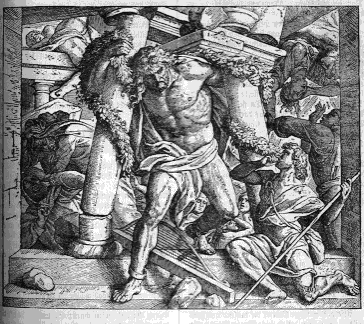 I don’t know if God has appointed Donald Trump to win the presidency. I know he is making a lot of people mad, but I see a lot of similarities to the
  The Eclectic Rant